 wilson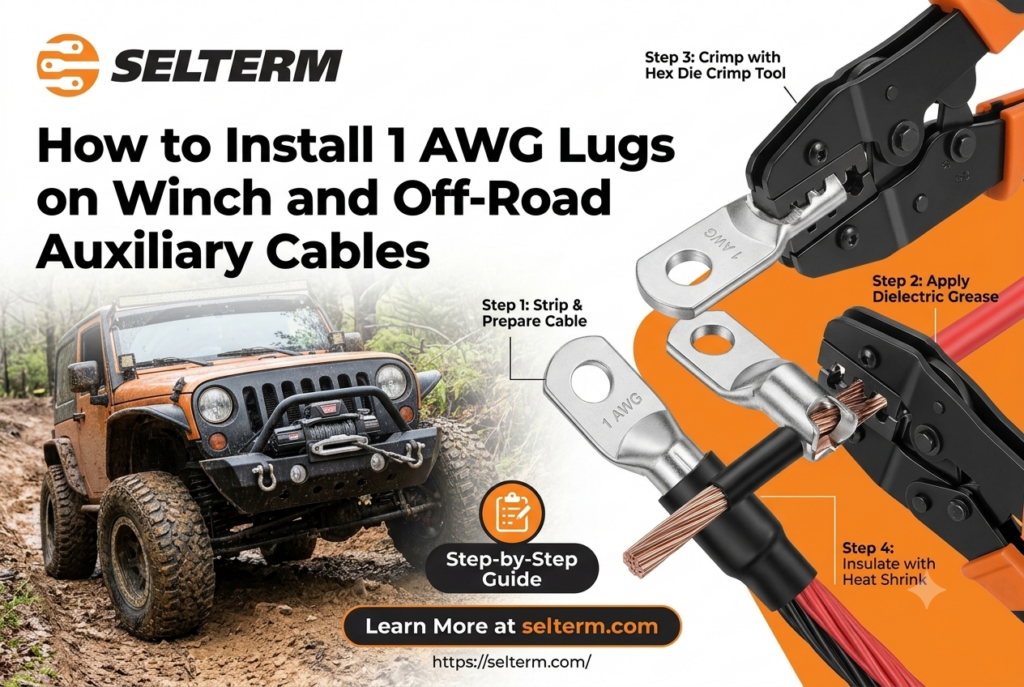
A winch can pull thousands of pounds
The cable connecting it to the battery has to handle serious current without turning the connection into the weak point.
That’s where the lug comes in.
When you’re working with a winch, auxiliary battery, recovery setup, or other high-current off-road equipment, the cable might get most of the attention. The terminal at each end deserves just as much care. A loose connection or badly fitted lug can create resistance, heat, and voltage drop right when you need the system to work.
For larger battery cables, a 1 AWG copper lug is a common choice when the cable and application call for that size.
Installing one isn’t particularly complicated. But there are a few things worth getting right before the crimping tool comes out.
Why 1 AWG Cable Is Used in Off-Road Systems
Winches can draw substantial current, particularly under heavy load. The exact current depends on the winch, motor, load, cable length, battery voltage, and operating conditions.
That’s why the cable connecting the battery to a winch needs to be sized for the actual installation.
A larger conductor can help limit voltage drop over the cable run. This matters with winches because they’re often mounted some distance from the battery, usually at the front of the vehicle.
The cable may also be routed through areas exposed to vibration, mud, water, heat, and movement.
In that environment, you want the entire connection to be dependable.
That includes the lug.
What Makes a 1 AWG Lug Different?
The first thing to check is the cable size.
A 1 AWG lug is made to accept 1 AWG cable. Don’t assume a lug will work simply because the cable can physically be pushed into the barrel.
The conductor needs to fit properly inside the barrel so that the crimp can compress it correctly.
There’s another measurement to check too: the mounting hole.
A lug may be designed for 1 AWG cable but available with different stud-hole sizes. Your winch terminal, battery post, busbar, or other connection point determines which one you need.
So before ordering, check both:
- The cable gauge
- The stud or bolt diameter
It’s a small detail, but getting it wrong means the lug won’t sit properly on the connection point.
Cut the Cable Cleanly
Once you’ve confirmed the lug size, measure the cable for the installation.
Don’t make the cable unnecessarily tight. Winch and auxiliary battery cables need enough length to follow their intended route without putting constant strain on the terminals.
At the same time, avoid leaving huge loops of spare cable hanging around the engine bay.
Cut the cable squarely.
A clean cut makes it easier to insert the conductor fully into the lug barrel. If the strands are badly spread or damaged during cutting, trim the end again rather than trying to tidy it up with your fingers.
Strip Only What You Need
This part is easy to rush.
Use a suitable cable stripper and remove enough insulation for the conductor to enter the lug barrel fully.
Try not to nick or cut the copper strands.
With a large battery cable, losing strands isn’t something to ignore. The conductor needs to remain intact so the finished cable can carry the current it’s designed for.
Slide the lug over the exposed conductor and make sure the copper reaches the intended depth inside the barrel.
If the lug has an inspection opening, you may be able to see whether the conductor has reached the correct position.
Before crimping, give the cable a quick look from all sides. Is the insulation close enough to the barrel? Are any strands sticking out? Does the conductor sit straight?
It’s much easier to fix now.
Crimping the Lug
This is where the right tool matters.
A 1 AWG cable is considerably larger than the small wires found in ordinary automotive circuits. A basic hand crimper isn’t necessarily suitable for a heavy battery lug.
Use a crimping tool designed for the lug and cable size. Depending on the terminal and installation, that could mean a heavy-duty mechanical or hydraulic crimper.
Follow the lug manufacturer’s recommended crimp location and method.
The objective is controlled compression that secures the conductor inside the barrel.
Don’t improvise with a hammer, bench vice, or another tool just because the terminal looks like it can be flattened.
It might look tight afterward. That doesn’t mean you’ve created a reliable electrical or mechanical connection.
After crimping, give the cable a firm pull. The conductor shouldn’t move inside the lug.
Check the Connection Before Installing It
Take a minute to inspect the finished crimp.
You’re looking for a lug that’s firmly attached, with no obvious cracking or deformation outside the intended crimp area. The copper shouldn’t be loose, and there shouldn’t be excessive exposed conductors between the insulation and lug.
If you’ve made a mistake, don’t try to hide it with heat shrink.
Cut the lug off and start again.
Heat-shrink tubing can protect and tidy a finished connection, but it can’t repair a bad crimp.
Connecting the Lug to a Winch
Once both ends are prepared, the lug can be installed onto the winch terminal or other connection point.
Make sure the mounting hole matches the stud.
Clean contact surfaces are important too. Paint, dirt, corrosion, or other material between the lug and connection point can interfere with the electrical connection.
Position the lug properly and tighten the fastener according to the winch or equipment manufacturer’s specifications.
Don’t guess at torque if the manufacturer provides a specification.
The same principle applies at the battery end.
Think About Cable Routing
A beautifully crimped lug won’t help much if the cable is routed where it can get damaged.
Keep heavy cables away from:
- Sharp edges
- Exhaust components and excessive heat
- Moving suspension or steering components
- Places where the cable can get pinched
- Areas where repeated rubbing could wear through the insulation
Use appropriate clamps or securing points to prevent the cable from moving around.
Off-road vehicles get shaken around. A cable that looks perfectly secure in the driveway can move considerably once the vehicle is bouncing over rocks and rough trails.
Give it a little attention now.
A Quick Inspection Before You Hit the Trail
Before using the winch or auxiliary equipment, look over the complete circuit.
Check that the cable is the correct size, the 1 AWG copper lug matches the cable, and the mounting hole fits the terminal hardware.
Then look at the crimp.
Is the cable firmly held? Is the connection clean? Are the fasteners secure? Is the cable protected along its route?
Also make sure the system has the appropriate fuse or circuit protection where required by the equipment manufacturer and vehicle setup.
Heavy cables can carry a lot of current. That makes proper protection just as important as choosing the right cable and lug.
The Lug Is Part of the Cable
When you’re building a winch or auxiliary power circuit, it’s tempting to think of the lug as the final little piece you attach after everything else is done.
It isn’t.
The lug becomes part of the finished connection, and its fit and installation can affect how reliably the whole circuit performs.
If your setup calls for 1 AWG cable, choose a properly sized lug, use the correct crimping method, and take the time to make the connection cleanly.
For 1 AWG lugs and battery cable ends, you can explore the available options from Selterm.
FAQ
Can I use a hammer-style punch crimper for 1 AWG winch lugs?
You can in an emergency, but it isn’t ideal for winches. Hammer crimpers punch a single notch into the side of the lug barrel, which often distorts the mounting pad and leaves empty air gaps inside the copper strands. A hydraulic hex crimper squeezes from all sides, creating a far better low-resistance connection for high-amp winches.
What stud size do I need for my winch solenoid and battery?
Most off-road winch solenoids and control boxes use 5/16″ (M8) studs. Top-post battery terminals, disconnect switches, and heavy ground points often require 3/8″ (M10) ring eyelets. Always measure your equipment studs before ordering your 1 AWG lugs.
Should I solder my 1 AWG lugs instead of crimping them?
Crimping is strongly preferred for off-road and automotive setups. High-draw winches generate enough heat to soften solder, and continuous vehicle vibration can cause soldered joints to crack at the wire transition point. A mechanical hex crimp combined with adhesive heat shrink handles heat and vibration much better over time.
Why are my winch cables getting hot during a pull?
A little warmth during an extended heavy pull is normal because winches draw huge current. However, if the cable ends or lugs become too hot to touch, you likely have loose bolts, corroded wire strands inside an open lug, or an improperly crimped terminal creating high electrical resistance.